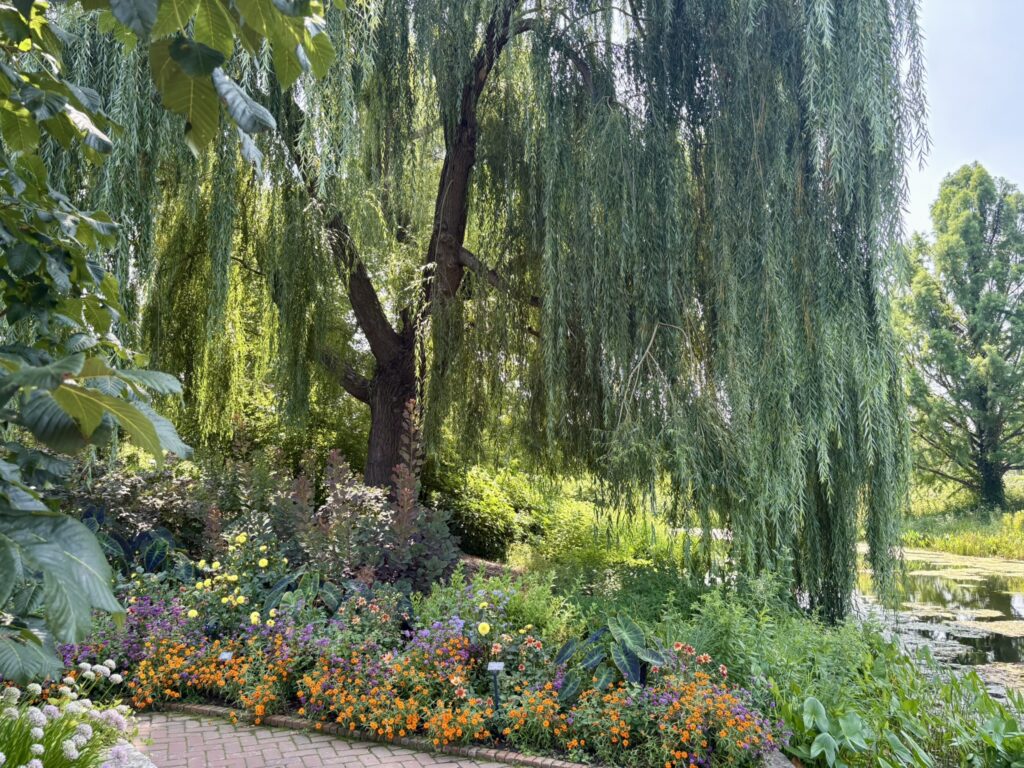
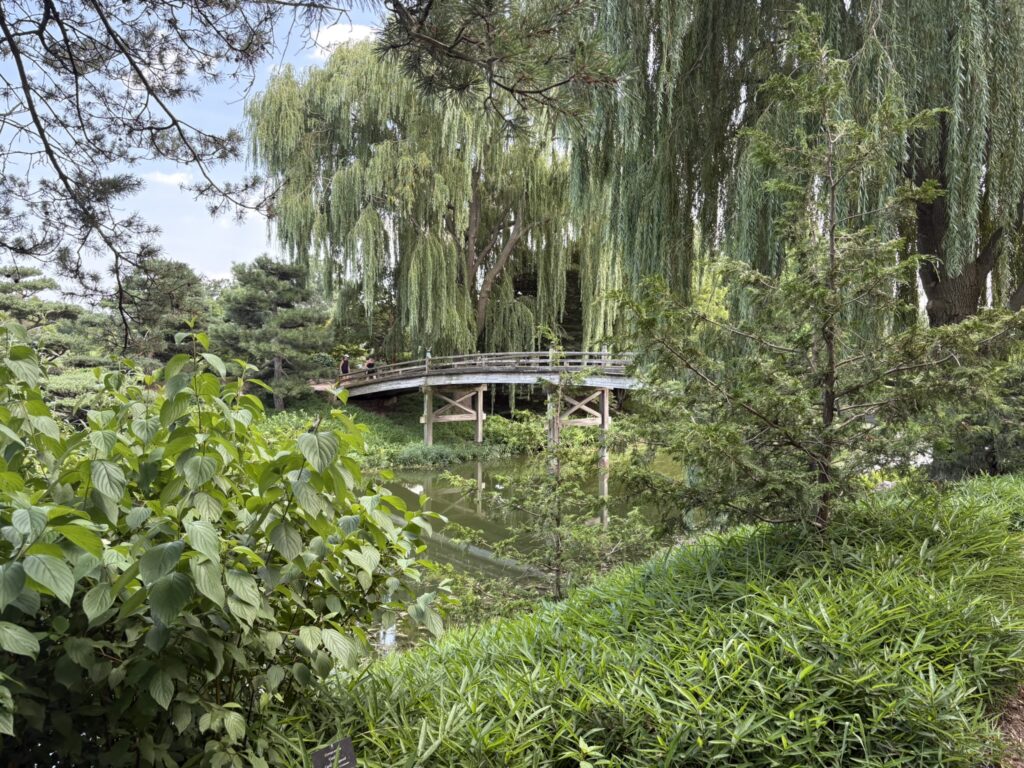
Salix babylonica– Weeping Willow. the most iconic of the weeping trees. And don’t you love the name?! Babylonica brings to mind the hanging gardens of Babylon, the most beautiful of ancient gardens. Just the mention of a weeping willow conjures visions of lounging idly by a lake edge in its gorgeous, cool shade. There is a romantic notion attached to these trees with its bright green long leaves and soft shape. The perfect subject for an impressionist painting. I have Debussy’s Clare de Lune playing as I write this post- a sweet and softly dramatic tune that invokes a sense of romance. Seemed very appropriate as I work on this post.
There are a few other weeping trees I wanted to show you that have a beautiful character and sometimes an amusing shape. None are quite as amazing as the weeping willow, but they are certainly less problematic and require less water. The roots of a weeping willow are aggressive and invasive into your sewer and water pipes. And the size of the tree can be overwhelming to a lot of gardens. It is best left to areas with natural underground water and large parcels.
Other Popular Weeping Trees
Another of the most recognized weeping trees is the weeping Cherry
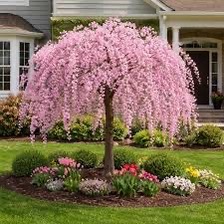


People flock to Japanese gardens and park areas in the Spring to see the fragrant, soft flowers of the Flowering Cherry and Weeping Flowering Cherry (they are ornamental and don’t develop fruit). You can see why! So beautiful and for a brief time in the Spring, these trees mark the change of seasons from Winter to Spring. There are many Festivals in the U.S. and around the world celebrating the bloom of the Cherries. They are available in single and double flowering varieties in both pink and white. The middle photo above is a double flower. Cherries are adapted to very wide climate variations but must be watered regularly, in the dry months, to keep them from having dead sections. The pruning of a weeping tree is tricky so it is best to have an experienced arborist help you with the pruning. They require well drained soil that is a balanced pH and that has organic matter mixed in.
A similar tree to the weeping flowering Cherry is the weeping flowering Crabapple. The flowers are larger as is the tree.
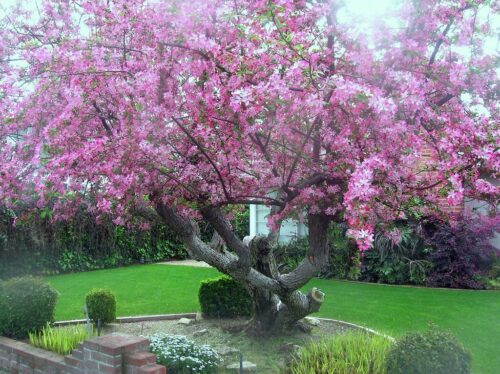
I love this tree! It is absolutely stunning! and wide so use in a large space.
One of the best alternates to the Weeping Willow is the Mayten Tree


The hybrid ‘Green Showers’ is a very nice looking tree. Smaller than a weeping willow and without so many root issues, these trees are a great alternate. They are an evergreen tree and grow to 30-50′ tall and 20′ wide. They like a well drained soil with watering once or twice a month in the dry season. Water deeply with all trees to avoid an abundance of surface roots.
Evergreen trees filter down a litter of leaves and flowers throughout the year, unlike deciduous trees which tend to drop their leaves in fall. The Mayten leaves are small enough to breakdown easily in garden beds. My clients have noticed that the seedlings can come up from roots and seeds in the garden, so clean up the areas below the tree 3-4 times a year and pull any unwanted seedlings. I have noticed that they can have a certain lifetime (much like the Weeping Willow) and die off after 20-30 years or more. Just a heads up that it is not a live for centuries tree like Oaks and Cedars.
Japanese Maples can take on a weeping character, especially the dwarf varieties.


Lace leaf Japanese Maples have a beautiful shape and cascading character. The finely divided leaves are truly lacy. Available in many dwarf hybrids they grow to varied heights from 3′-8′ approx. and spreading just as wide. Depending on the hybrid, they can be green or red.
Japanese Maples are sensitive to the hot sun and should have only morning sun and afternoon shade or be in a lightly shaded woodland. They are deciduous trees. Rich soil with lots of organic matter is best but they are surprisingly adaptable. Prune sparingly and never shear a Japanese Maple. When they are cared for well they have a very long life. All Maples should be watered in the dry months. Water twice a month deeply.
European White Birch is an extremely popular tree and, though it isn’t considered a weeping tree, it does have pendulous branches and leaflets. It also provides a light shade below small, bright green leaves.
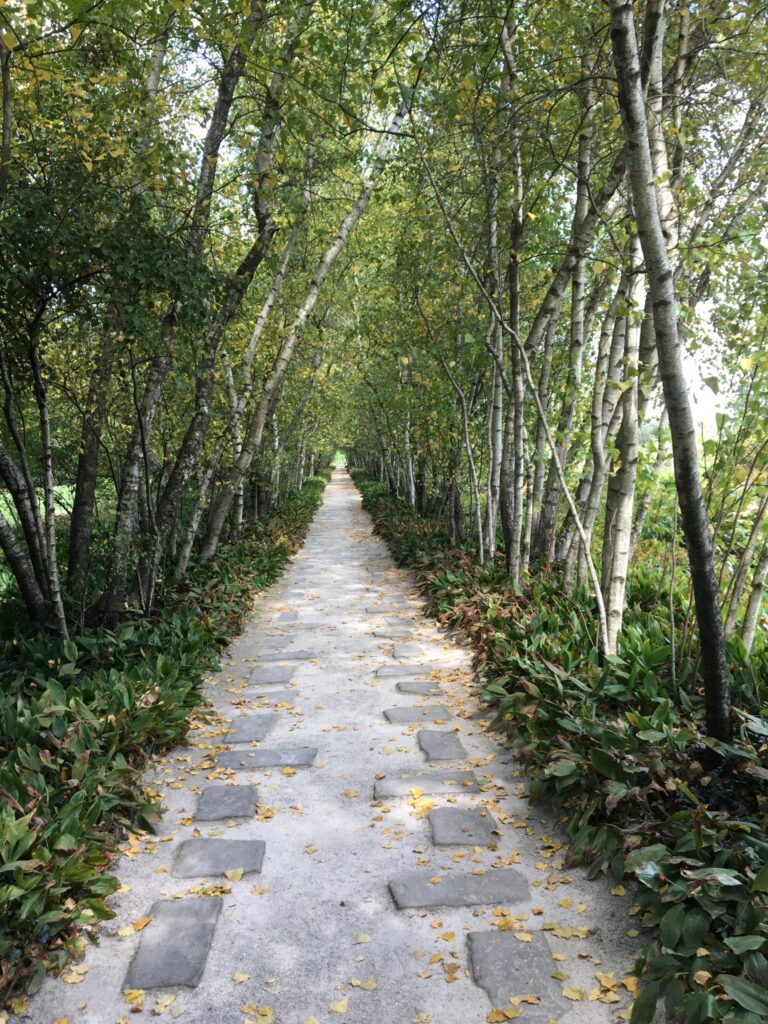
Birch love a moist environment and many died off on the west coast during the severe droughts. It likes being near lawn or area with regular watering. Birch are deciduous trees and like rich soil and regular maintenance.
Wisteria is a vine but takes on a tree size trunk and top.


It is really the flowers that are weeping, but I have included it here because the leaves cast a similar shade to the weeping willow and mayten. The flowers come on in the spring and are fragrant. Wisteria is a deciduous plant. The flowers are followed by long pods, so if you don’t want to have pods hanging down just prune the vine after the flowering cycle or prune off the pods. The pods are fuzzy and approx. 3-4″ long. They can be interesting in arrangements. The flowers wilt when cut, so aren’t great as cut flowers.
Wisteria is a vine that needs a hefty support, but standards or tree form is available in nurseries. They do tendril out and twine around anything within reach so keep the tendrils in check.
These vines are very adaptable and once established they take long dry periods well. I water ours every couple of weeks to keep them full. The bloom cycle is brief, but the light green leaves and fall color are very pretty. Soil type can be clay to typical garden soil and, for a good bloom a once a year pruning is helpful in the dormant season. Fertilize after pruning with a balanced fertilizer for blooming plants.
Weeping Tilia is a beautiful tree that I had not been familiar with, as it is not grown on the West Coast. Tilia or American Basswood or Linden, has large rounded leaves in a bright green and large growth size.


There is a dwarf of the Weeping Tilia- ‘dwarf weeper’ or ‘pendula nana’ that grows 3-4′ high while the standard weeping Linden grows to 70′ high and 40′ wide. Also know as the Pendant Silver Linden. They are deciduous trees and have a very attractive shape as a weeping tree. The flowers are fragrant, small greenish white 5 petaled type. Some of the Tilia species prefer a limestone based soil. Most of the species prefer a soil rich in organic matter and minerals. They need ample moisture which is probably one of the reasons we don’t see them on the West Coast commonly. I also saw the standard trees of Linden pollarded or trimmed back hard in winter at the Longwood Gardens.
Weeping Conifers
Conifers are trees and plants with needles or scales rather than leaves and are typically evergreen. There are many dwarf and special hybrids of Cedars, Spruce, Fir, Larch, Cypress, Pine etc…………


One of the most common Weeping Conifers is the weeping Cedar. And it is a large plant although it is considered a dwarf Cedar. Reaching out with long arms or branches with branchlets cascading off the main branch, it is a striking plant. There are both silver and green versions.
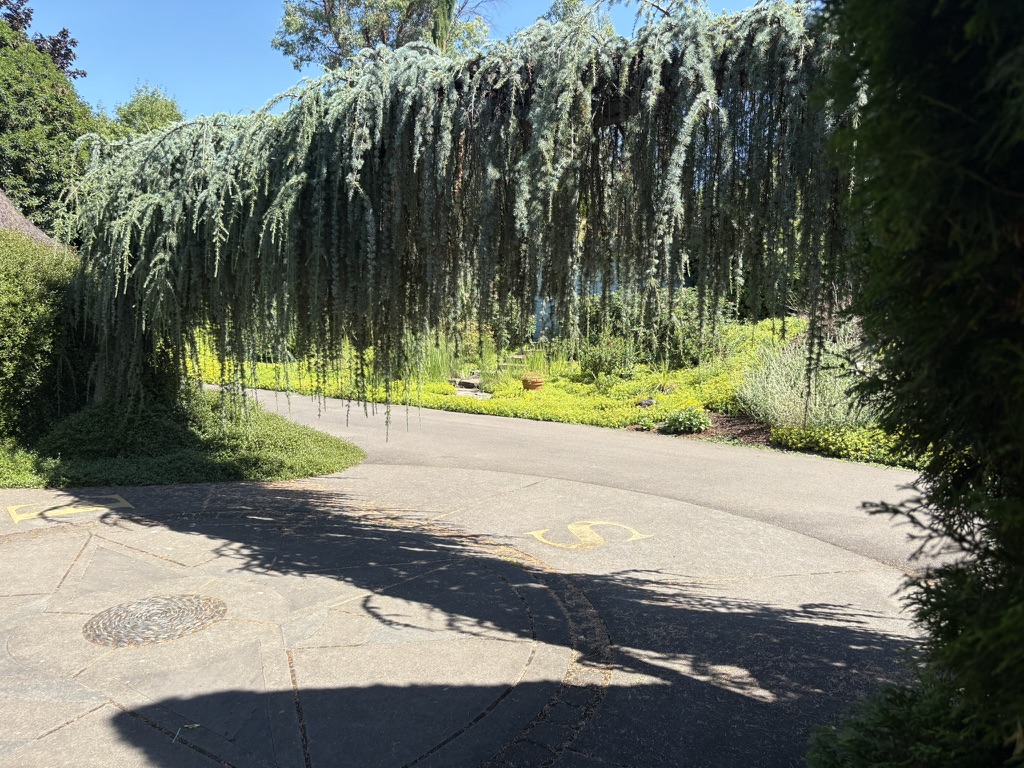
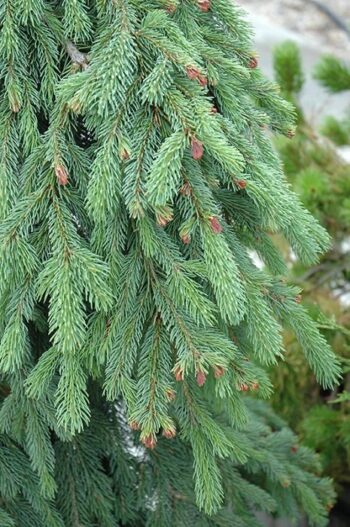
Spruce make a lovely weeping dwarf and they have needles running all the way around the twigs.
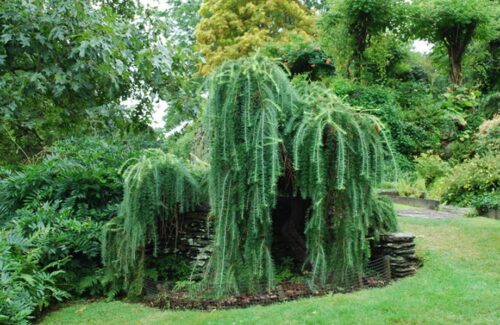
The Larch is similar and special pruning is needed to avoid an awkward shape to the trees.
Conifers struggle in the dry heat on the west coast and in the interior valleys so I am enjoying my trips to Botanical Gardens on the East Coast, the Pacific Northwest and Mid-West where large collections of hybrid conifers are more common. I love the weird and wonderful shapes of the weeping and dwarf conifers and their uses in specialized gardens. Conifers are typically very long lived trees. On the West Coast- Cedars, Redwoods and Cypress do well and survive the prolonged droughts normally.
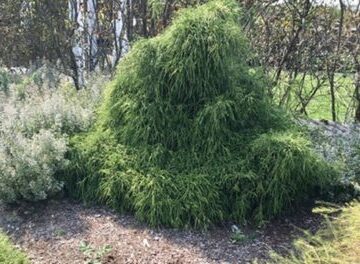
The “shaggy” Cypress is another great dwarf and sometimes resembles a large creature that may get up and amble away. The flat, scaled foliage give it a more smooth look than other weeping conifers.
Purple Leaf Weeping Beech
Here is a very unusual tree
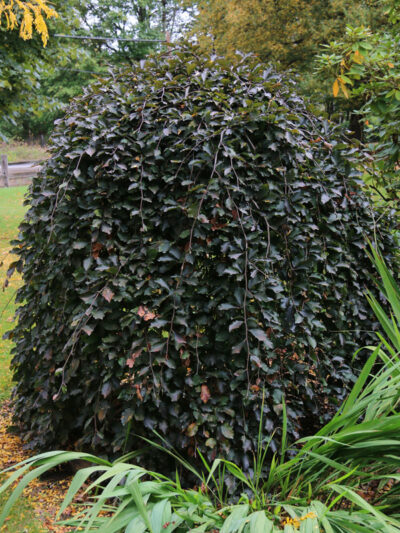
Easily burned, as are many of the purple leafed hybrids, this weeping Beech has an amazing look and draws you across the garden to see what in the world it could be. This is a dwarf variety and can be taller than this one but remains a small tree. It likes consistent watering and a soil rich in amendment or organic matter. It is a good contrast to the many green leaves in the garden. Very pretty combined with lime and chartreuse colored plants.
Drought Tolerant Weeping Trees
There aren’t many but three stand out – Melaleuca, Geijera and Callistemon. All three are evergreen trees.
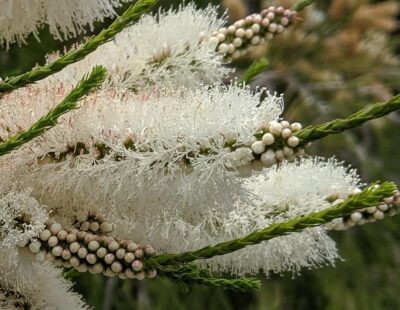


Melalueca is a vey hardy and adaptable plant in the drought prone regions and originally comes from Australia. The papery bark is also interesting on this evergreen tree. The hybrids that have a weeping appearance are these white flowering type. Melaleuca also has hybrids in pink. Considered a small tree they usually get 15-30′ tall. These trees are tolerant of heavy alkaline soil. Bees love the flowers, as there are many on one stalk.
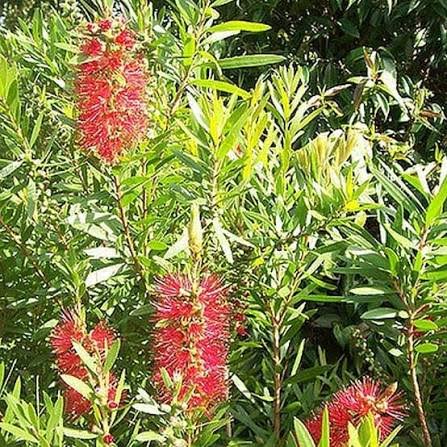
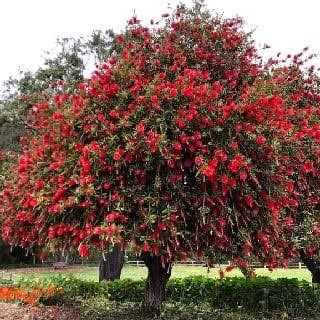
A similar small tree is weeping Callistemon citrinus- lemon Bottlebrush. It also has a hybrid with pendulous branches and is adapted to very low water and heavy soils.
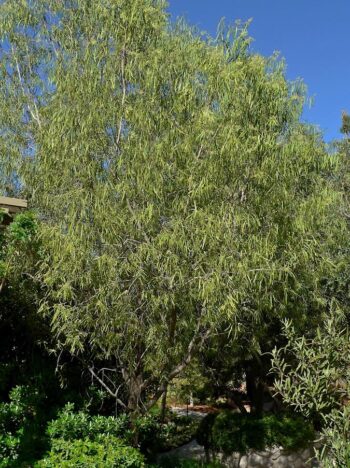
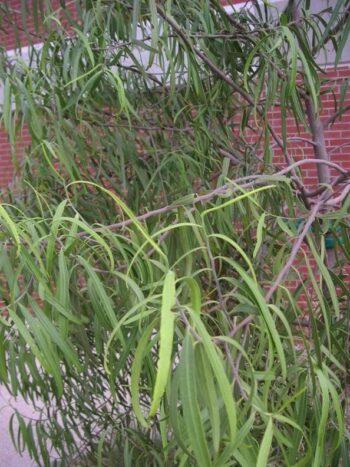
Geijera– Australian Willow is another tough and heat resistant tree. Geijera is best with good drainage but tolerates poor soil. It grows 30-40 high and has aromatic leaves. This tree had use by the Aboriginal peoples in making poultices for cuts and abrasions. It has small insignificant flowers. It can be damaged by freezes below 15-20 degrees in winter.
I hope you have enjoyed this article about weeping trees. This is not a complete list of all weeping trees, shrubs and vines, but covers some of the most attractive and commonly used types. Most weeping trees need plenty of space so if you have a large garden with a good spot that would fit a weeping tree go for it. They make a great backdrop to view to and an inviting place to relax.
Many of the pictured featured in this blog were taken in Botanic Gardens around the U.S.. I visit many gardens and like to go “Garden Traveling”. The product of these trip is the Travelogue. It is a monthly newsletter available through this website with beautiful pictures and information about Botanic Gardens, Arboretums and Parks around the U.S.A.. Here is a link to the travelogue page:
Check it out!