
Antique Garden Ornaments that are not just Ornamental
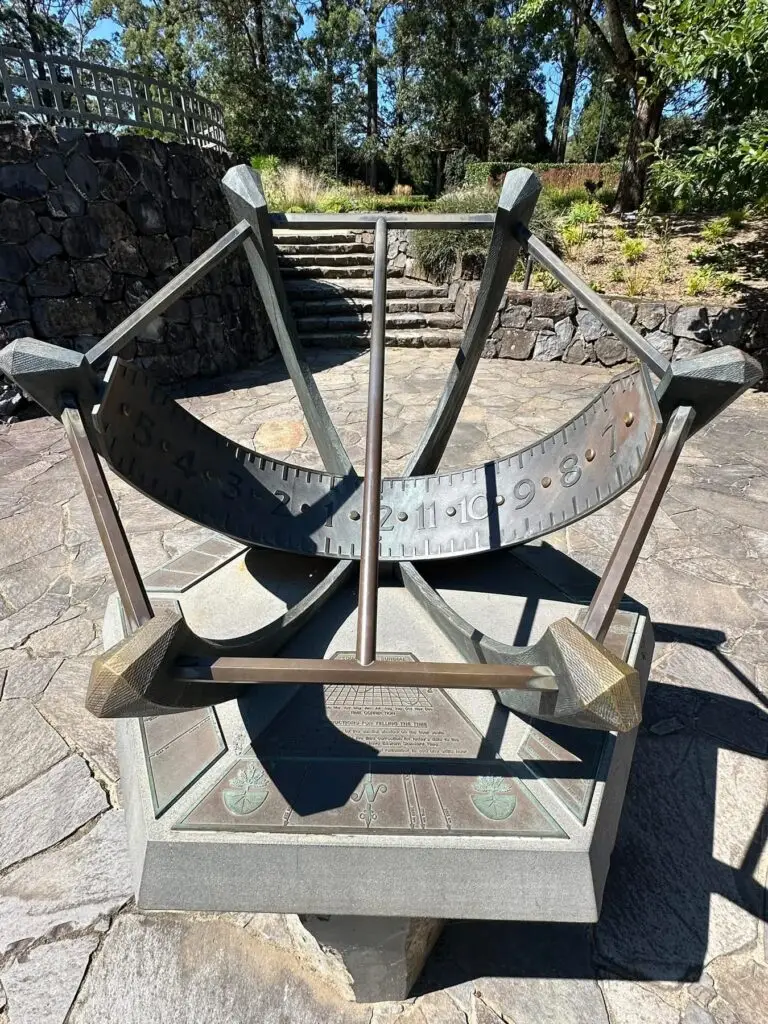
While traveling to Botanical and Public Gardens around the U.S., I have come across many very decorative and intriguing sundials and armillaries. Not well versed in their usage or familiar with the rudiments of their design, I decided to study up. I had taken photos of them to share with my readers, but I also wanted to give some of the facts that explain why sundials and armillary spheres have remained a much treasured part of classical gardens.
Luckily, we have an excellent horticultural library at the Los Angeles County Arboretum. Not satisfied with simply looking up the information on the web, I headed over to the library and checked out these three books.
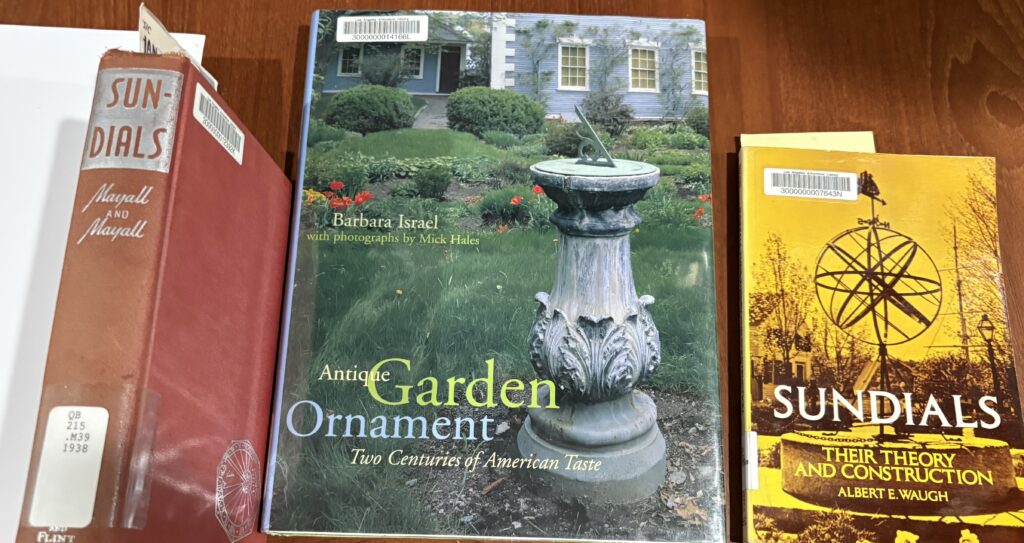
Sundials by Mayall and Mayall published by Hale, Cushman and Flint Publishers in 1938, Antique Garden Ornament by Barbara Israel published by Harry N. Abrams Inc. in 1999 and Sundials by Albert Waugh published by Dover Publications in 1973. All of these books turned out to be excellent references and are written clearly and precisely. I was happy to read that some of the sundials and armillaries I have photographed are among the most famous and original of their kind. I also read a lot of informational material on Wikipedia, to have a well rounded view of the history, practice and construction of sundials.
I won’t try to repeat the whole of all that was included in my research, but will give you the outline of their history, basic methods of the use of sundials, their decorative function in the garden and some sundial trivia that I found interesting and sometimes amusing.
Measuring Time
That man took note of the movement of the Sun and the shadows that came with that movement is the source for the development of the first time keeping tools. Firstly, as a simple rod driven into the earth in an inscribed circle and later as the first rudimentary sundials or clocks. The sundial starts with the fairly basic concept of an object casting a shadow on the markings of a dial indicating the hour of the day. As the Sun moves the shadow moves from hour to hour.
It is interesting that cultures far distant from each other came up with similar methods of counting the parts of the day independently of each other. We can set 1500 b.c. as a pin point in history when the sundial became a standard method of telling time in early civilized regions. Egypt, Babylonia, Assyrian tribes all have a part in the history of sundial development and theory.
In China, time keeping dates back to a similar period with the gui biao, which had a vertical pole paired with a horizontal measuring plate. Into the 1900’s portable sundials were still used in common practice in China and Japan.
The Mayans also had an advanced understanding of Astronomy and used tall columns called Stelae and their matching alters to cast shadows over large plazas with figures marked in the stone, forming massive astronomical clocks.
As the science of astronomy developed further, it was learned that it is not the Sun that moves, but the Earth orbiting the Sun while rotating on its axis that causes the Sun to rise and set. However, in the first models of the universe the Earth was shown as its center and the other planets and stars moved around it.
It was the Greek astronomers that gathered together much of the knowledge and practices involving sundials and made significant corrections and additions in designing the dials and the apparatus that casts shade, called the gnomon. The Roman empire spread the use of sundials throughout their empire. And introduced the instrument to India. The sundial is mentioned in the old testament biblical text and the many works of early Greek and Roman astronomers.
The development of trigonometry by the Greek mathematician, astronomer and geographer Hipparchus (190-120 B.C.) and further developed by Albategnius (latinized name) or al- Battani (858-929 A.D.) in Arabia gave the mathematical formulas and calculations that made the dial markings accurate and precise.
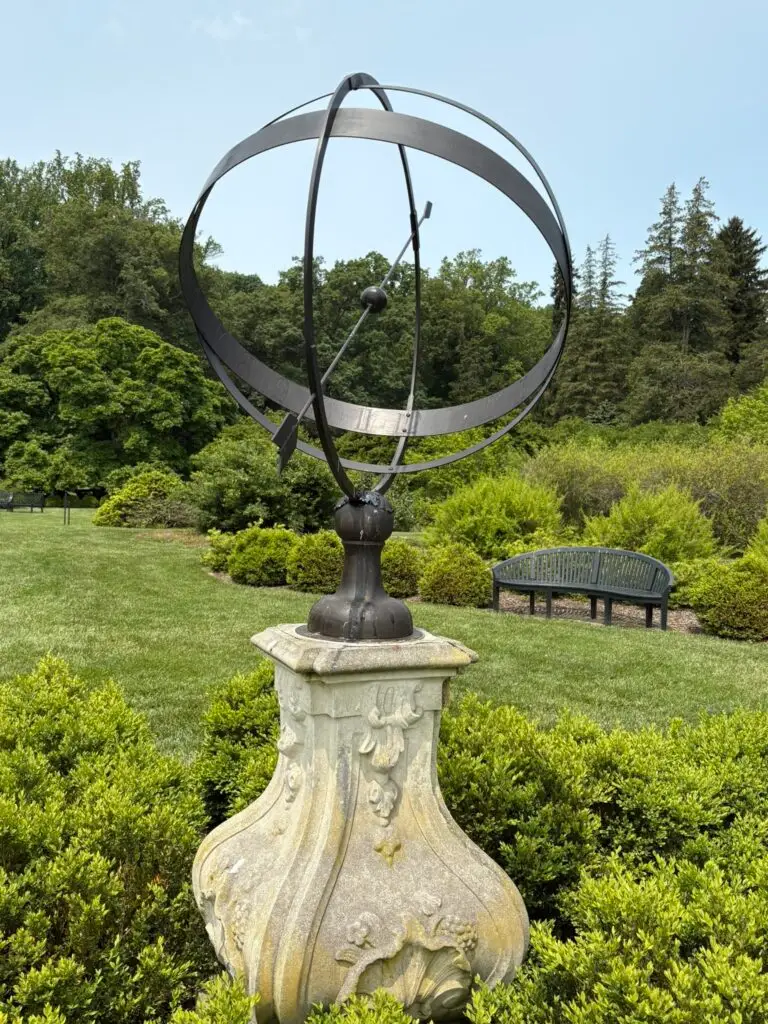
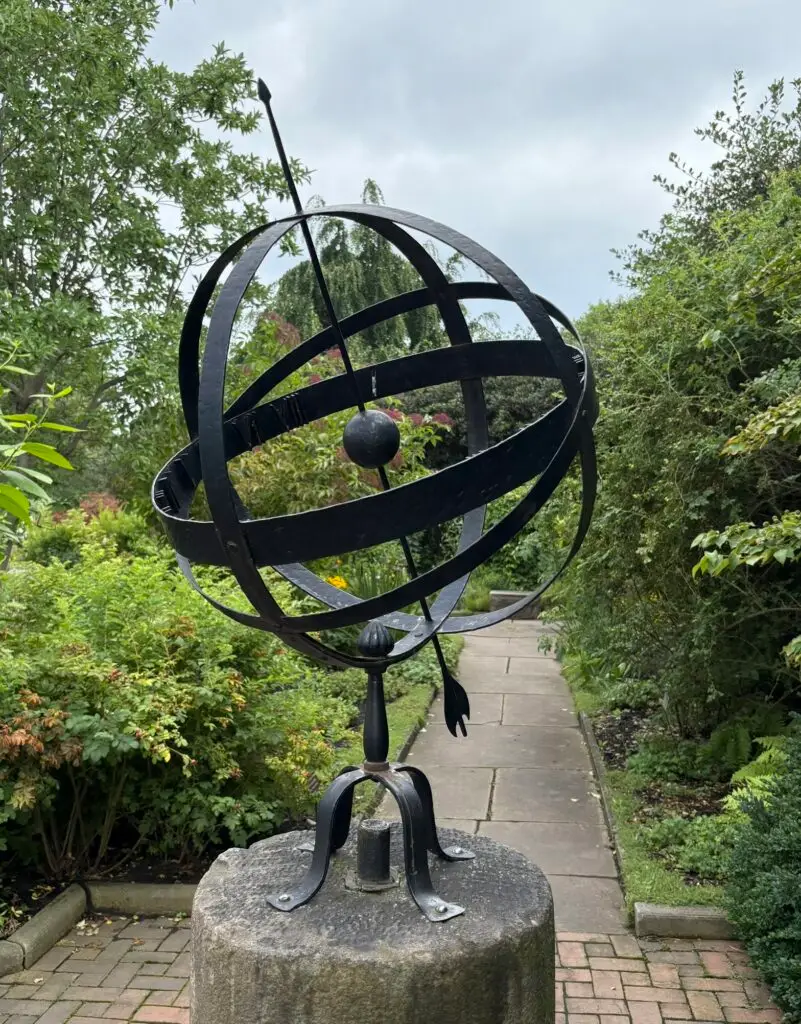
The armillary was first designed by mathematician, astronomer, scholar and philosopher Erastosthenes in Alexandra in the year 225 B.C ( this discovery and design was also credited to Hipparcus, a Greek astronomer working in +/-200 B.C.). A series of rings intended to show the heavens encircling the earth. Typically, a ring set horizontally to represent the horizon, another ring set to illustrate the celestial equator and the third ring is a true north south line or meridian circle. An arrow or rod is welded in, to cast the shadow on the rings of the sphere. There can be other rings in the sphere too. Rings. with markings for the symbols of the Zodiac and rings to mark dates important to the person or community where the armillary resides. The armilly is most often used in history as an astronomical tool rather than a tool for telling time, however, when set up as means to determine time it can be extremely accurate.
Quantifying Time
One of the most fascinating aspects of researching this subject was the history around how, and who first made the divisions of time, seasons, and months of the year. Of course, these practices were put into place through ongoing observation over thousands of years, but to understand where the most common practices of our lives originated is illuminating. And also how the relationships of the numbering of these time keeping practices came into place, gives even more meaning to studying sundials and armillaries.
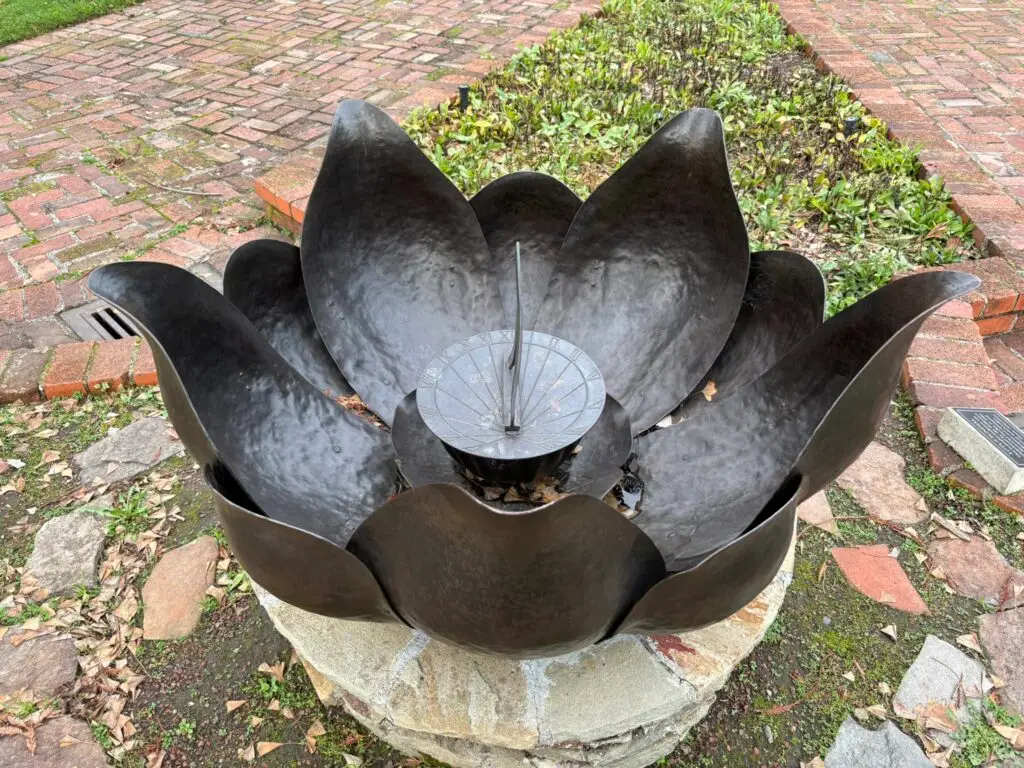
We can trace the introduction of equal hours throughout the day to an Arabian fellow named Abul-Hassan who lived in the beginning of the 13th century. He introduced the concept, but it wasn’t until the time of Copernicus that the idea gained traction. Copernicus (1473-1543) devised the theory that the Planets orbit the Sun, not the Earth. As his theory became accepted and trigonometry gave precision to determining the markings of dials then equal hours began to become accepted and the present scientific sun dial took on its common look.
The quantifying of time derives from the 360 degree circular orbit of the planet Earth around the sun.
The 360 degree circle of the orbit is broken up into 60 equal parts of 60 minutes of degrees each. Each minute has also 60 seconds of degrees. You sometimes hear locations given with a latitude and longitude degree number plus a number for minutes and seconds, this gives a precise location on the planet.
When the celestial equator is broken up into 24 equal parts, to complete the hours of day and night, each segment of the circle is 15 degrees or 1 hour. I should clarify by stating that the celestial equator is the imagined circle around the earth, in space, directly out from the horizon (where the sun sets and rises).
The Sun does not actually stay exactly lined up with the celestial equator throughout the year so there is a slight variation of about +/- 10 min. in summer and winter. This has been titled as “sun slow” and “sun fast”- often a table of these variations for each month/day are located near or on the dial, so that the minutes can be added or subtracted from the reading on the dial to give the exact time. The fact that early watches and train tables were set to the time given on sundials gives you an idea of the accuracy that was achieved. Although early watches were not always that accurate in keeping time!
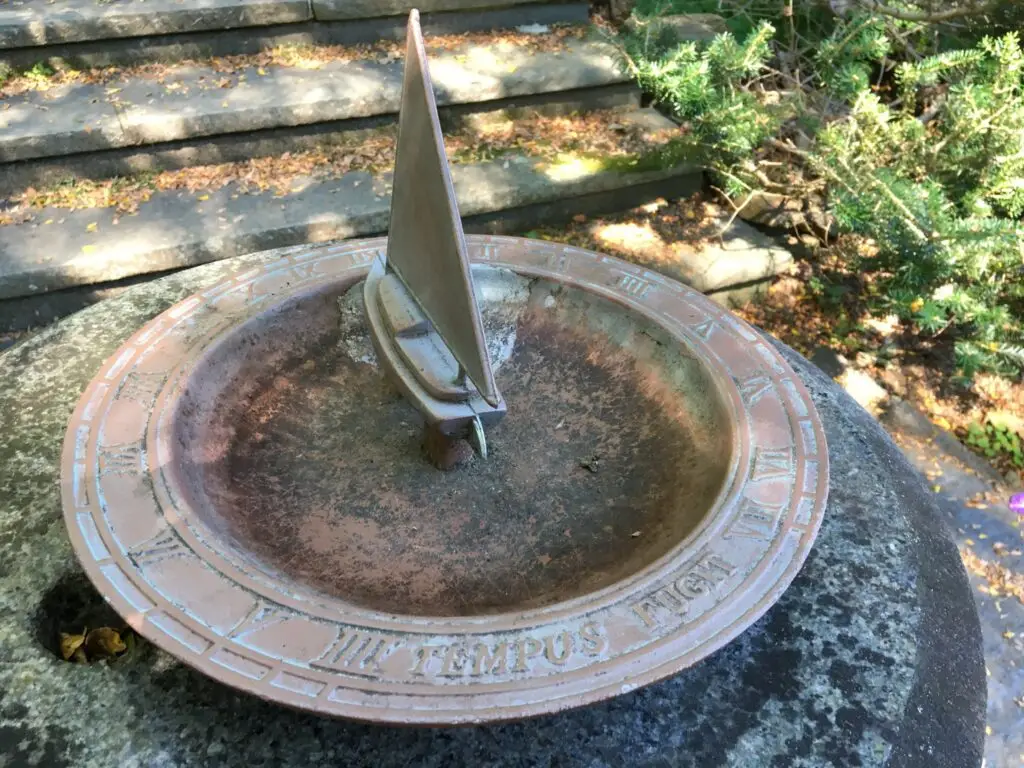
Having said that, there are many factors involved in the setting and the construction of the sundial and armillary sphere for any particular location. Latitude being one of the main factors. A sturdy and leveled base is also important when setting up these instruments. One cannot just purchase a prefab. sundial and point it towards north and think that it will give accurate time.
The photo above shows a little pond with a sail boat. The edge of the pond has the hour markings of the sun dial and a motto. The sail of the boat acts as the gnomon and has an upper sharp edge called the style. The bottom of the sail or gnomon is the sub-style and is usually mounted on the dial plate of horizontal sundials. The angle of the style is set to the latitude in degrees, minutes and seconds of the place that the sundial is located. The upright part of the gnomon is set to point to true north and XII or 12 on the dial plate markings. With the sun setting roughly around 6 pm and rising near 6 am, a sun dial only has the useful hours of that time period. Cloudy and shaded sun dials also limits their use. Some dials also mark time by moon light, but they are rare.
The division of the year into calendar months is even more ancient dating back in Mesopotamia over 5000 years ago, when ancient civilizations use lunar cycles to determine the passage of time over a year. Other great civilizations had also developed calendars based on astronomy. But it was the Roman king Numa Pompilius (753-672 B.C.) who set the year for the calendar as 12 months, building upon previous study. The observation of the Moon, Sun and Stars and the young science of astronomy led to how we frame our years.
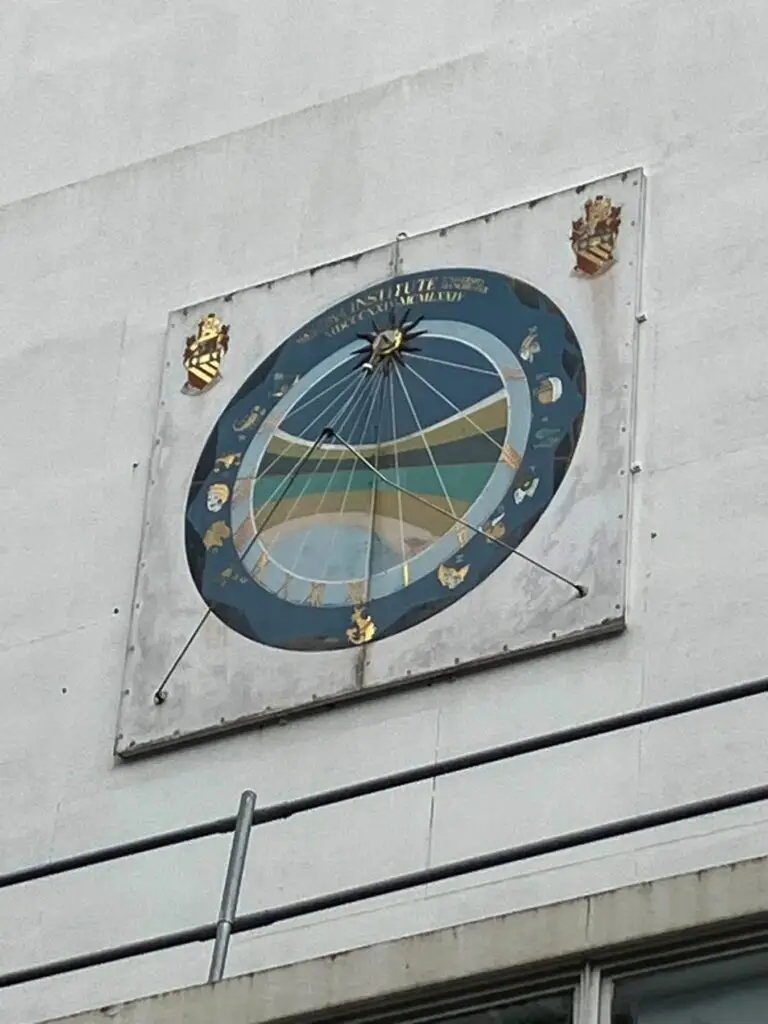
The ancient civilizations also used their observations as farmers and students of the sky to break up the year into seasons. Based on the flood cycles of the Nile River, Movement of the Sun and Stars to guide planting and noting how this movement affected crops, helped early cultures to divide the year into the 4 seasons. Today, we know that the Earth’s axial tilt is the contributing factor in determining seasonal change.
The vertical sundial shown above has markings for the time of day, seasons of the year, and Zodiac phases
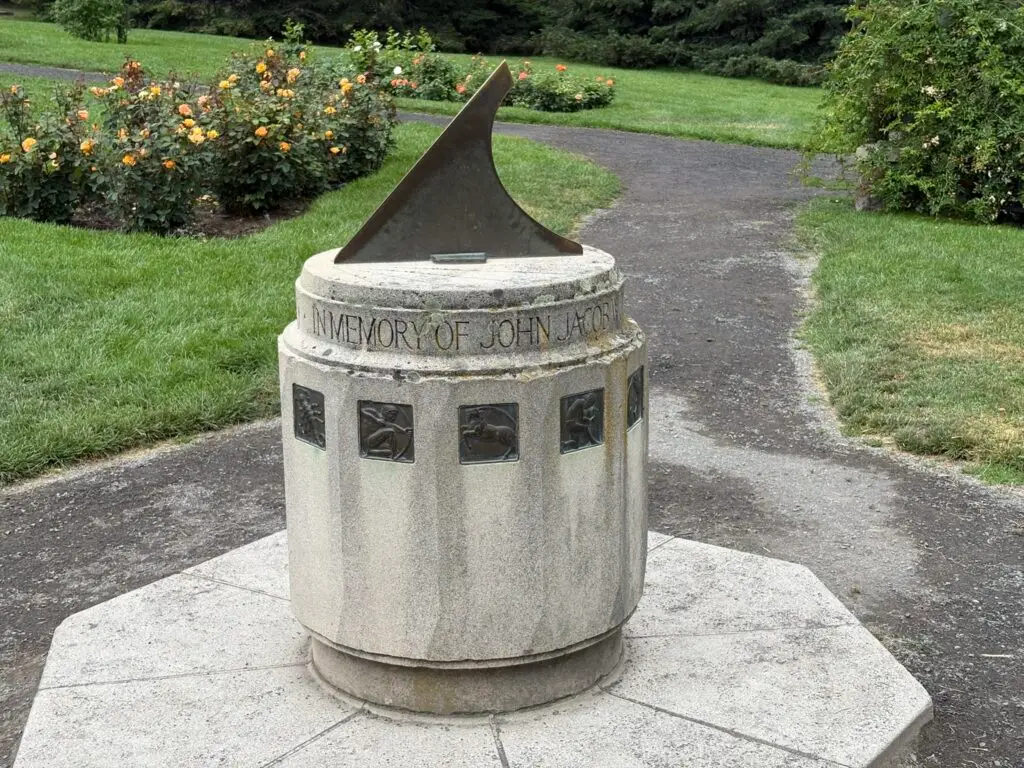
It was this sundial that peaked my interest in astronomical clocks. The small figures around the outside of the column are bas relief Zodiac figures set on facets around the column that line up with the markings on the base below. Just as the shadow of the gnomon indicates the time of day the column acts as a gnomon casting a shadow on the side of the column and paving indicating the time of year. The day I took this photo it was overcast, so no shadow.
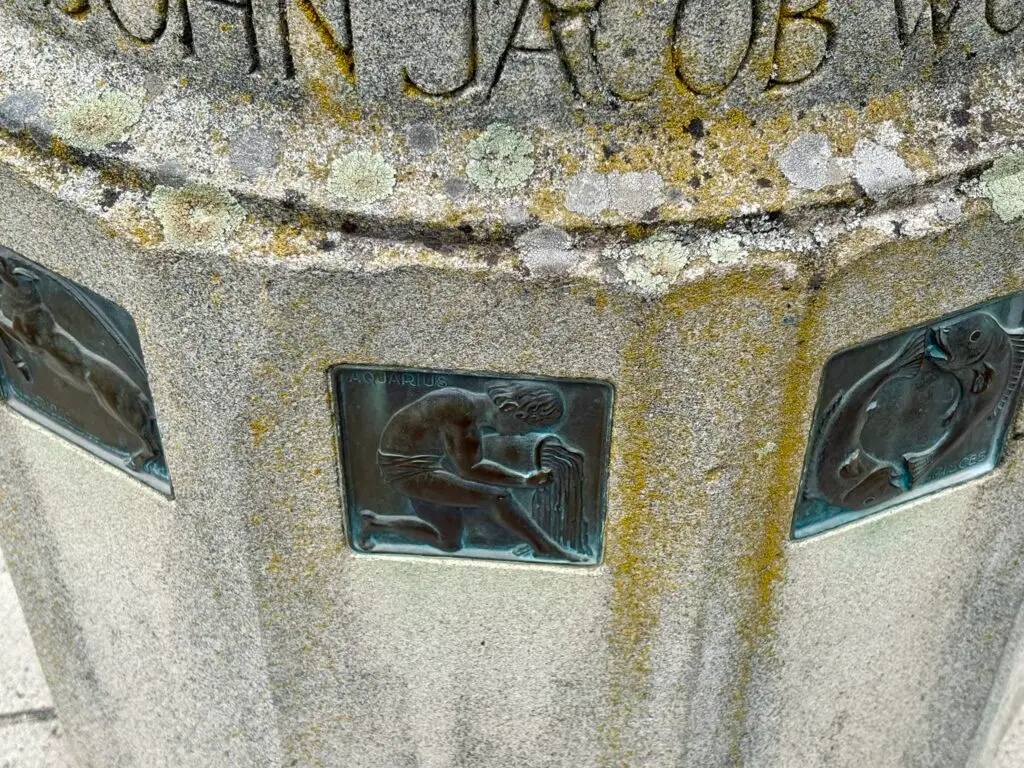
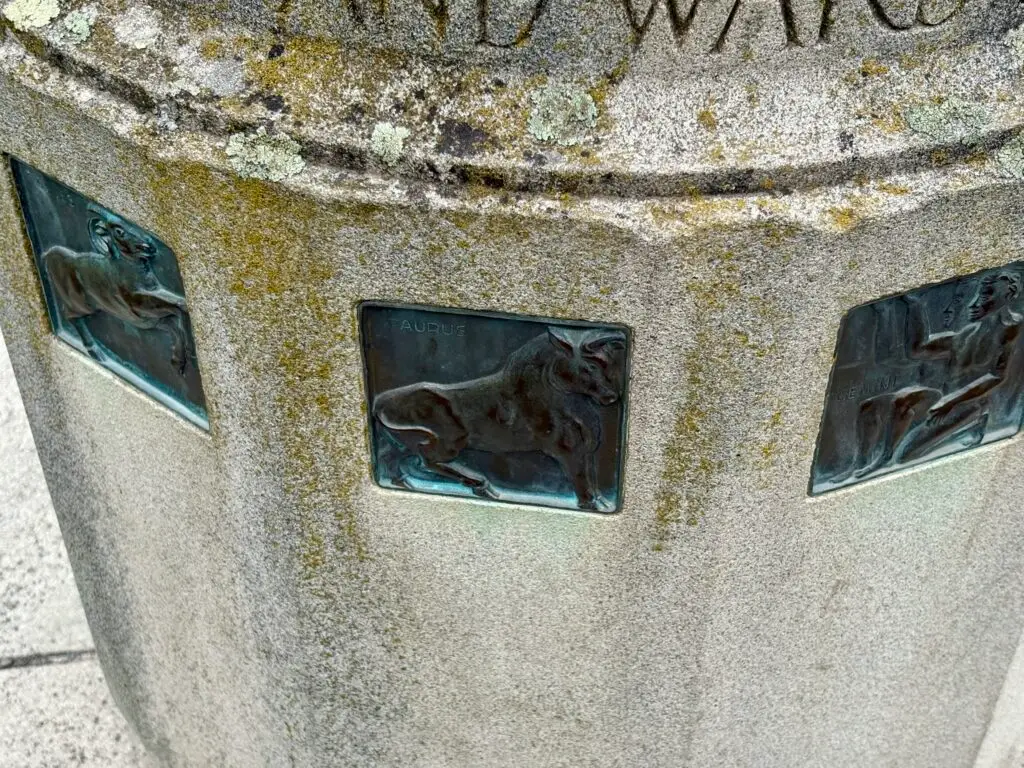
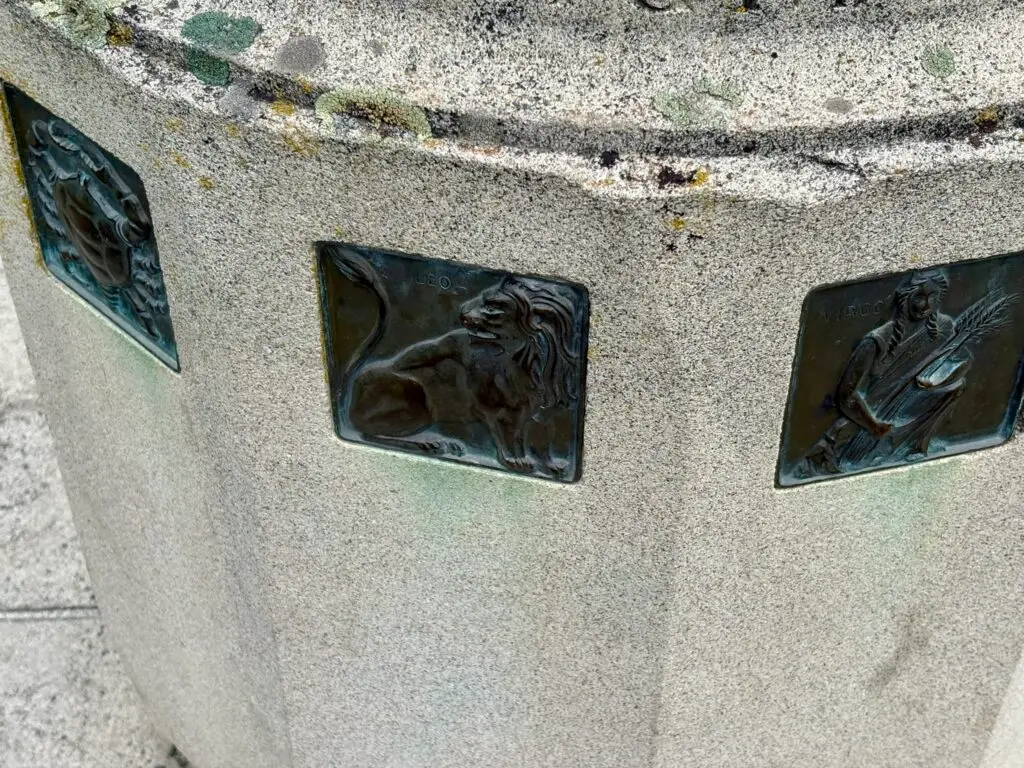
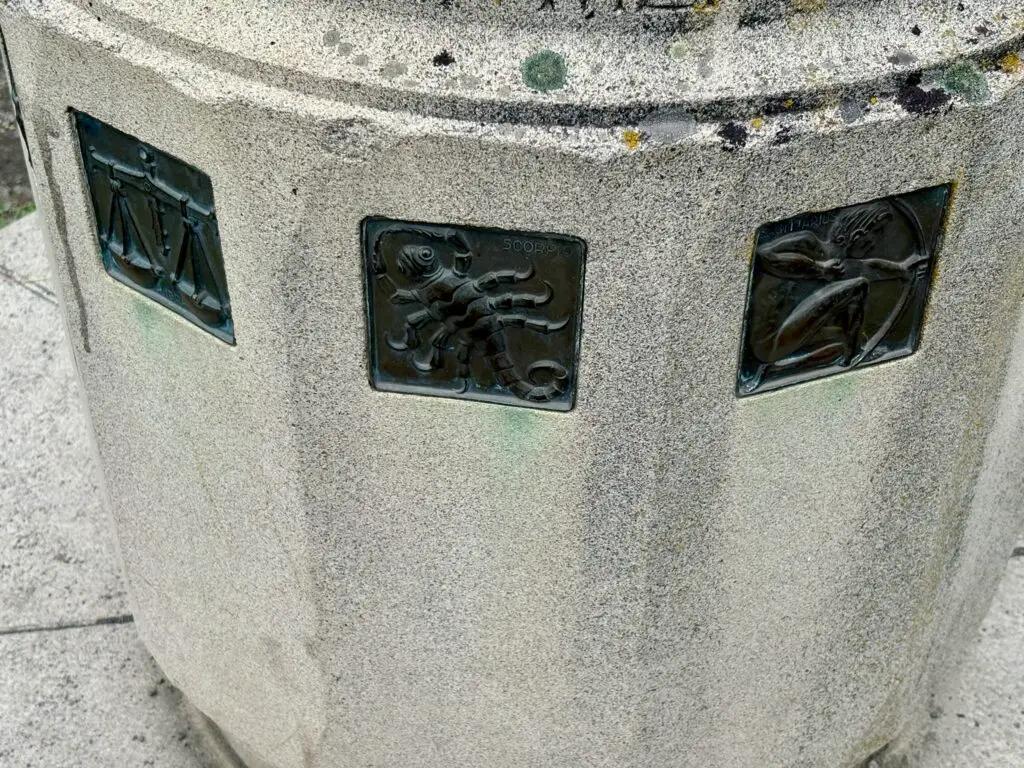
I love these small astrological figures on the plaques. This sundial is Manito Park in Spokane, WA by the rose garden and gazebo.
A Multitude of Variations
Sundials have quite a few variations in look and how they are set with the horizontal dial set on a post being the most common. Although sundials are not common at all anymore. Occasionally, in older towns and cities in Europe or the Mediterranean you may see a large metal pin stuck in a wall and a pattern or number on the wall, this is a noon mark used by the town’s folk to note the time of day. Sundials and Armillary Spheres may be found in classic or historic gardens, old estates and town squares that have remained unchanged for many centuries.
I read a through a multitude of pages of calculations, construction methods and varied information on all types of astronomical clocks. For this article I have only scratched the surface of all there is to know about these instruments. One of my favorite items, from my reading, was the fact that the information shown on a sundial is called its furniture. This would include the numerals and markings, the gnomon, a motto (if included), any notes on corrections or charts and decorative illustrations.
Besides the horizontal dial there are also vertical sundials on walls, sundials aligned with the equator (called Equatorial sundials), sundials set up for walls that are at angle and even portable sundials that were very popular before the advent of accurate pocket watches. George Washington was given a portable sundial by Lafayette at the time of the American Revolution.
The Sundial and Armillary Sphere as a Garden Ornament
There is probably a 50/50 chance that a sundial or armillary that you come across in a park or garden actually works as it should to tell the time. Many are antiques brought from other places and set up as a garden ornament for the public to wonder over. They may have a beautifully carved pillar or base and an exceptional series of interlaces circles, but don’t function as a real time piece. This is from lack of knowledge on the part of the installer and owner of the piece. An old sundial would have to have a new or modified gnomon correcting for the latitude of its new home to work properly. An armillary sphere has a better chance of being moved as they are normally set up to use the earths equator as its horizontal plane. A correction of the angle of the armillary can be made when mounting it on a new base.
Happily, many of the great, old estate gardens have involved the work of very professional designers and garden superintendents who are, or were, versed in the practical knowledge involved with ordering and placing an astronomical clock. Specialized sculptors and metal workers produce these sundials. They take into account the mathematics involved in determining the markings, mounting and angles of the parts of the sundial while also considering the aesthetics of the garden ornament and how it will fit in with its surroundings.
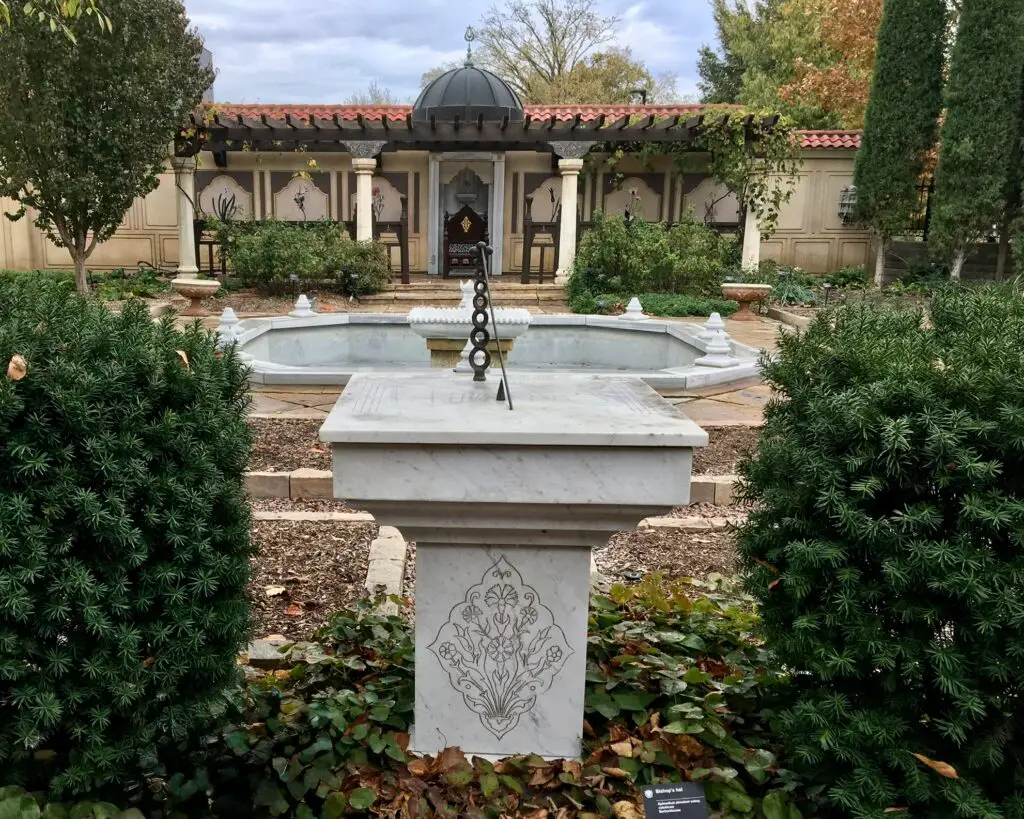
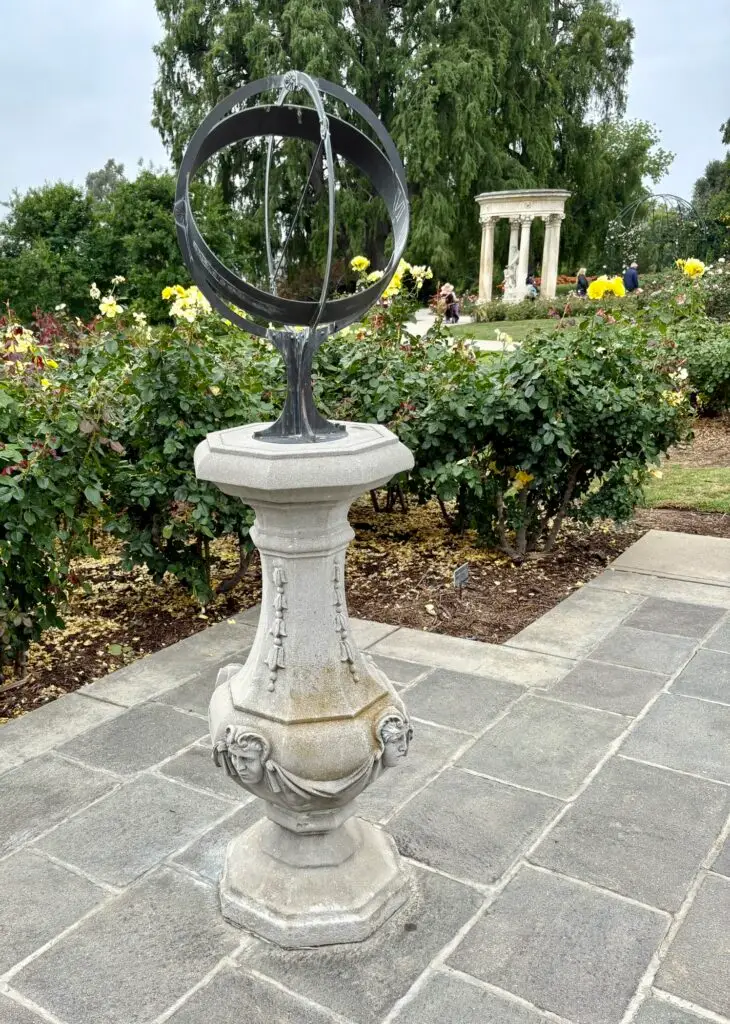
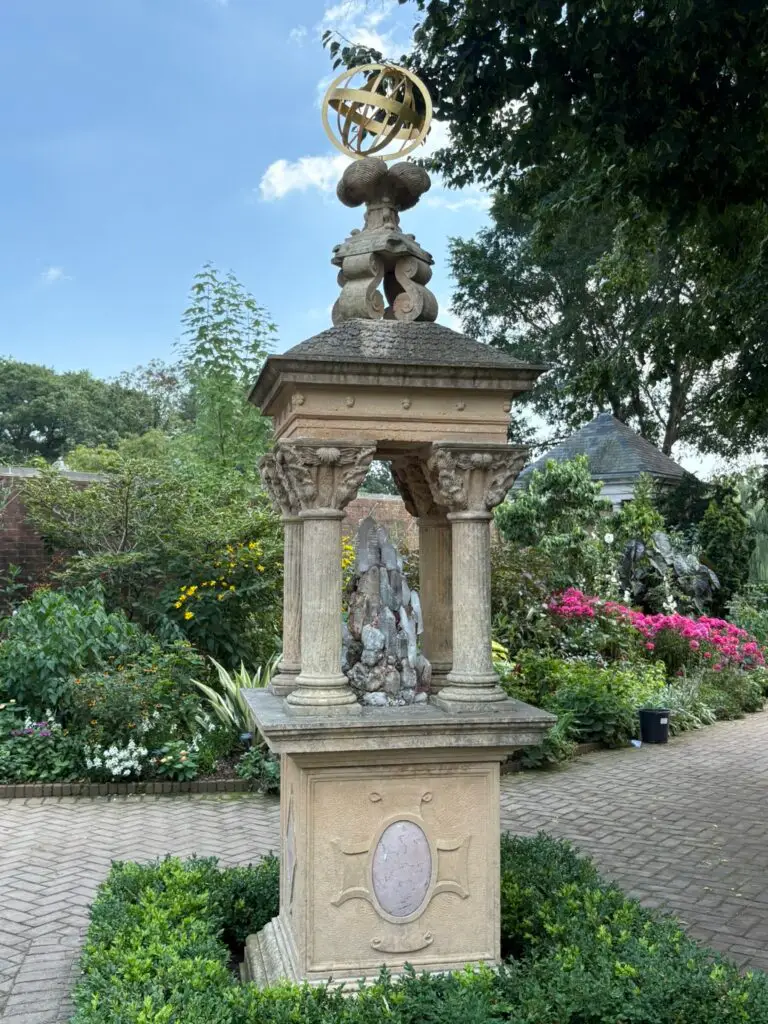
Great example of a purely decorative armillary sphere mounted so high up on this amazing masonry creation that you could never read it, even if it was set up to show time of day. Seen at the Chicago Botanical Garden
I feel like I have hopscotched through the history, theory and practice of the sundial. Its a blog after all so is very abbreviated in its coverage. My aim was to give you a sense of the background and antiquity of the sundial. A bit of insight on how our timekeeping came about and perhaps an insight as to how to approach and appreciate sundials and armillary spheres. They are more than just a lovely statue in a garden. They have an incredibly long history from the very beginnings of civilization through the development of the science of astronomy and mathematics. People counted on these instruments for thousands of years and placed them at the centers of their great cities. Their closely related sisters were the astrolabe and heliochronometer, The first made history in navigation allowing for accurate astronomic readings at sea, while the latter is a high precision instrument converting solar time to standard mean time. These quiet relics of antiquity may stand at the intersection of two paths in an old garden, but what they really represent is a cross roads in history where time became defined and days took shape.