And Plants that give a Bonsai effect
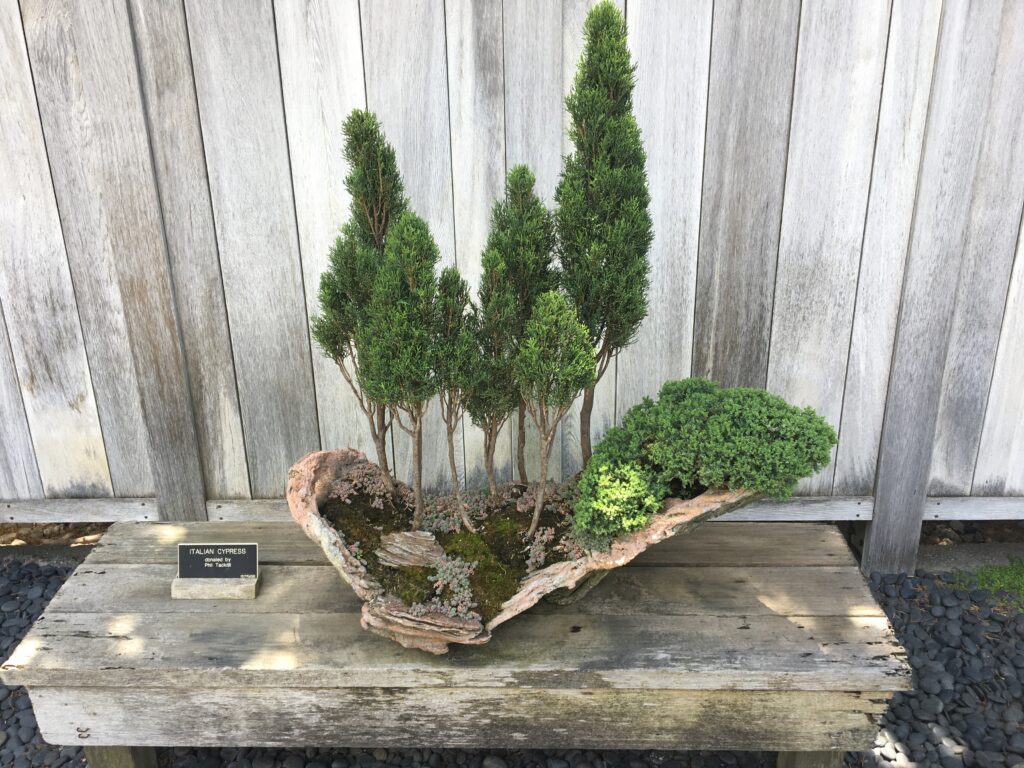
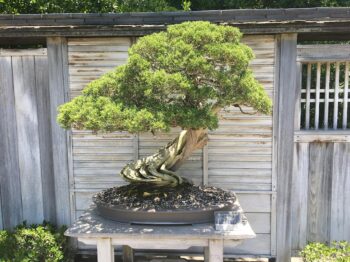
This is a great example photo for the concept of the art of Bonsai. A miniature of an entire forest and surround in a tiny container. I love that the artist used a natural piece of wood for the container. Italian Cypress is reduced to just a foot high while a creeping Juniper, that is usually a large mat, is just a small cushion of foliage.
Bonsai creations seek to represent a large natural scene in just a few feet of space. They are portable too! So you can take your forest, river, or pond with you. As Japanese cities and towns become more and more crowded (true worldwide) and living spaces are at a premium, the art of Bonsai fits well in the modern home. Although, the art dates back to the 4th century (or further) when Taoists believed that creating miniature versions of natural landscapes allowed people to capture and access the magical, spiritual properties of nature. Scenery in a pot, or Penjing, originated in China and later was introduced to Japan by Buddhist Monks (1185-1333 AD).
It is interesting that the philosophy of Penjing was heavily influenced in the Edo Period (1603-1867 AD) by wabisabi. As the practice of training trees in miniature migrated out of temples, Samurai and Aristocratic homes into the general population, the aesthetic philosophy of wabisabi or the beauty in impermanence, age and simplicity spurred the use of wire and intensive pruning into the art.
The name Bonsai came into use in the Meiji Period (1868-1912 AD) and derives from bon- meaning tray and sai-meaning growing plant. Today, the art and practice has spread throughout the world as a representation of the beauty and contemplation of nature. Many botanic gardens have collections of these curiously shaped trees. There are clubs devoted to training both the trees and plants and also enthusiasts who wish to learn how to practice the art of Bonsai.


Trees, shrubs and vines are all subjects that have been used for Bonsai. Interestingly shaped rocks, mosses, and small grasses or groundcovers have also found their way into these miniature landscapes. There is a subset of the art based around the use of naturally sculptured stones. This is called Suiseki or art of stone appreciation. The stand alone stone represents a mountain or mountain range, an island or a waterfall.
Ishizuki is a term used to describe a rock clinging Bonsai or tiny plants growing out of the crevices of a stone. The stone represents a rugged landscape, cliff or steep peak.
Saikei or tray landscape may have moss, sand, water or other accents with a sculptural center stone. The overall presentation represents topography in the natural landscape.
Japanese Gardens are considered a place of quiet contemplation and a place to appreciate nature. Bonsai also invites the viewer to spend a bit of time taking in the shapes, textures and settings of each small tree or dish garden. Many of the specimen trees are hundreds of years old and have been tended by multiple generations of Bonsai gardeners.
The trees don’t have to be very old, however, a person can train and grow a beautiful Bonsai in a relatively short amount of time using trees or plants that form up more quickly or lend themselves to a sculptural shape. Or, if you just love them, but have no time, they are available to purchase at most good nurseries or from club sales. Be sure to learn the care and feeding of your new pet!
Bonsai in the Landscape
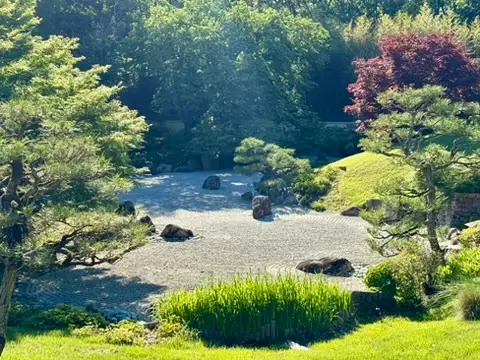
You probably have seen larger specimen of Pine or Juniper trained into a Bonsai shape in Japanese Gardens or peoples homes. Also a specialized form of gardening, in which an intensive pruning regimen is practiced over a long period of time. However, I want to suggest to the reader that appreciates these interesting shaped trees and plants that there some easy hybrids that take on a Bonsai shape with little pruning and training. How wonderful is that !?! In my work as a landscape designer I was able to use many such plants to achieve the look of a Bonsai shape without the care and attention of the full on Bonsai specimen. I also include here many plants that work well when you wish to create a Japanese Garden that is easy care.
Some of the plants that work well for this kind of look include the Dwarf Japanese Maples. With a small amount of pruning they can be opened up to reveal the inner branches and make the small trees look very sculptural. Japanese Maples can be grown in a container and pruned and shaped to form a graceful Bonsai.
Japanese Gardens have a large array of greens, but use bright colors of flowers sparingly. Azaleas with their brilliant magenta flowers are a lovely accent in the garden, and as they age they have a nice shape with little pruning. The deciduous Azaleas or Kurume hybrids are especially vibrant and are more open and demure. Azaleas are often used for containerized Bonsai.
There are several ground covers shown here. They have tight foliage and tend to fit themselves between boulders and large stones. Sarcococca humilis, Dymondia, Sedums, and Japanese Garden Juniper- Juniperus procumbens ‘nana’ are great examples of plants that have a tight, compact form. For larger gardens and slopes, Cotoneaster horizontalis- Rockspray Cotoneaster has a stiff, ground hugging manner that lends itself to the look of a trimmed, sculptural plant. It is used for actual Bonsai too,
Ferns are exceptional crevice plants and require very little care, but should have regular water and be out of the hot sun. Their delicate leaves and the patterns of their leaflets combine well with stones and other perennials. I show some Crocus in the photos also, which can pop up in Spring or Fall for a nice surprise.
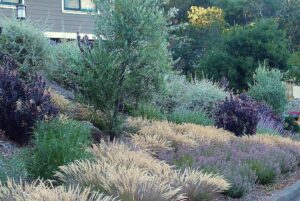
The second to last photo has a big group of Heather- Erica shown blooming in light pink. These plants hug the slopes of mountains and escarpments, not daunted by wind and rain, but loving the quick drainage. The low growing forms of Heather would be a good fit for an island of greenery in a Japanese Dry Rock stream or river area. A small Nandina is shown too. Nandina has many dwarf forms that are so easy care, colorful and low water that they are a perfect choice when trying to replicate the feel of a Japanese garden. They could even be used as a super easy Bonsai in a medium sized pot!


Small grasses such as Mondo Grass, Festuca ovina glauca and Liriope are very nice as path edgings, in small groups or set among stones. As a trendy addition, some of the succulents could be used in place of more tender foliages. They fit in areas with stones well, but prefer to be out of the hot sun.
Dwarf Conifers such as Spruce, Larch, Pine and Cypress fit well in a garden modeled on an Asian theme, of course, and they only require an occasional thinning and shaping to give them a nice look. There are even some very cool contorted forms of Dwarf Conifers that could work well. Unfortunately, in the dry Western States Conifers suffer from the drought and heat, making it very hard to keep them for very long. The wetter and cooler climates are better choices for Dwarf Conifers. Most can be used in large containers as a Bonsai with some regular pruning and shaping. They will need to be repotted every 3-5 years and root pruned to keep them healthy.
I had the great, good fortune of visiting a nursery in Sonoma County, CA that specialized in Japanese Maples and other specimen trees. They had a very interesting collection of Ginkgo trees there, with many dwarf forms among them. These would be great in a Japanese Garden setting and naturally form an interesting shape. I did grow ours in a large container as a natural Bonsai.
Tucked in with the ferns and grasses I have a few other perennials in the photos- Japanese Forest Grass- Hakonechloa macra is a gorgeous plant. It seems to need the same conditions and soil as ferns. I also show some large leaved Hostas, they could be gorgeous in a Japanese Garden. If you have snails and slugs in your area, they love to ruin Hostas so take precautions to keep them away from these plants.


You can see the waves of green and red foliage that are a hallmark of very mature and large gardens with specimen trees. Layers of leaf color, texture and varied form mimic the trees that populate the forests of the overall region.
The pretty blue flowering perennial is Lithodora, it loves good drainage and doesn’t mind some heat. Perfect for a boulder edging. And of course I show the beloved Weeping Flowering Cherry, a small tree that is one of the crown jewels of Spring. Their mild fragrance and loads of pink flowers are celebrated each year with the Cherry Blossom Festivals.
Most of these plants are shown in my plant Gallery on the website, with more information about them and some notes on growing them. Here is a link:
I also wrote a blog on Rockeries that has a lot of interesting, compact plants included. Here is a link:
Questions? Ideas? Need a plant I.D.? Please contact me through this website for more information. Thanks for reading and enjoy your Autumn!